- Lokales Ranking
- Google Maps
- Local SEO
- Google Bewertungen
Local ranking on Google: relevance, distance and prominence
Why does the competitor two streets away rank above you? The three factors behind local ranking, what reviews contribute – and a 90-day plan.

“Why does the competitor two streets away rank above us?” That question has an answer – Google describes the basis of local ranking itself. There are three factors, and only one of them can be built up systematically.
The three factors
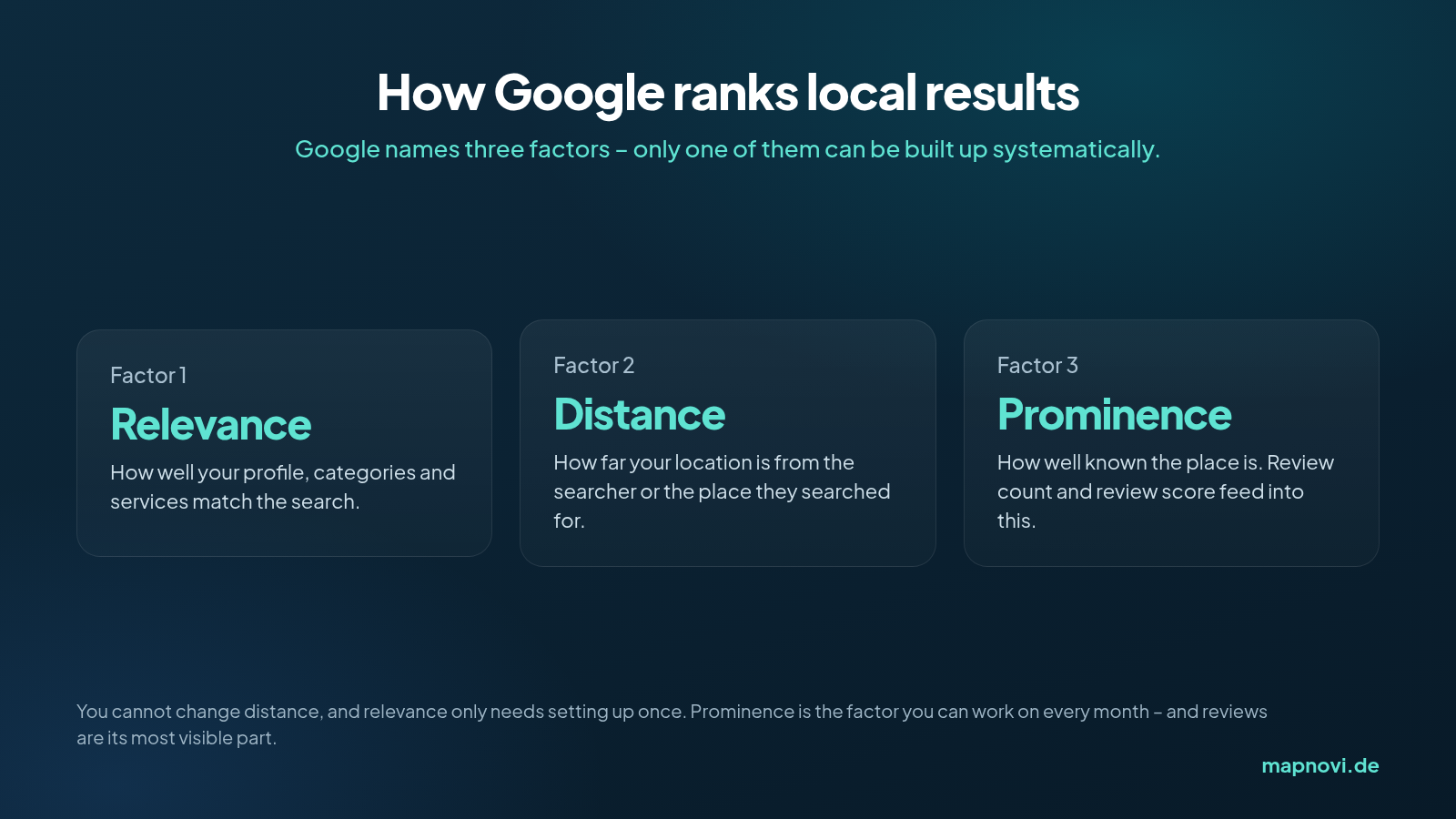
The three work together, not in sequence. A business with high prominence can outrank a closer competitor; a perfectly maintained profile does little if it sits 20 kilometres outside the search area.
Relevance: set it up properly once
Relevance describes how well your profile matches what somebody is searching for. This is the part you control directly – and the part most profiles leave on the table:
- The primary category has to hit your core business exactly, not approximately.
- Services and products belong in the profile in full, in your customers' language.
- The description should explain what you do – not be stuffed with search terms.
- Attributes answer questions many searchers use as filters.
The full list is in our Google Business Profile checklist.
Distance: the factor you cannot change
Google takes into account the distance between the searcher's location (or the place they searched for) and yours. Nothing can be done about that – other than opening more locations, which is a business decision, not an SEO measure.
Two consequences are still useful. First, “position 1” is not a fixed thing: it depends on where the searcher is standing. Second, it pays to strengthen relevance and prominence particularly where your customers actually come from.
Prominence: the factor you work on
Prominence describes how well known a place is overall. Google draws on what can be found about you across the web – mentions, links, directories – and explicitly names review count and review score as part of it.
That makes reviews the one ranking building block you can improve every week through normal day-to-day work. And it explains why a handful of policy-violating 1-star reviews damages not just the impression but the visibility too – we did the maths in How negative reviews hurt your location.
What reviews actually do
| Measure | Effect |
|---|---|
| Number of reviews | Counts towards prominence and stabilises the average: the more reviews you have, the less damage a single bad one does. |
| Average (stars) | Part of prominence – and a hard filter in Maps: with one tap users hide everything below 4.0 or 4.5. |
| Recency | A profile with reviews from this month looks alive; three-year-old reviews look like a closed business. |
| Owner replies | Change the overall impression for everyone reading along and make other customers more willing to review you. |
Why position 4 barely counts
Local search usually shows three entries directly. Not being there does not make you invisible – but it puts you one click away, and that click happens far less often. The goal of local optimisation is therefore not “appearing somewhere” but standing in those three boxes, for the terms customers actually search with.
What you can do in the next 90 days
- Week 1: go through the profile completely – categories, services, attributes, photos, opening hours.
- From week 2: a fixed routine for asking customers for reviews. Five to fifteen per cent of those asked will do it.
- Ongoing: reply to every review, within 48 hours at the latest.
- Once: go through every review that violates the policies and submit it.
- Monthly: note views, calls, review count and average.
One removed 1-star review moves the average as much as several new 5-star reviews – and it works immediately.
Enter your location and have your reviews checked – with no upfront payment.